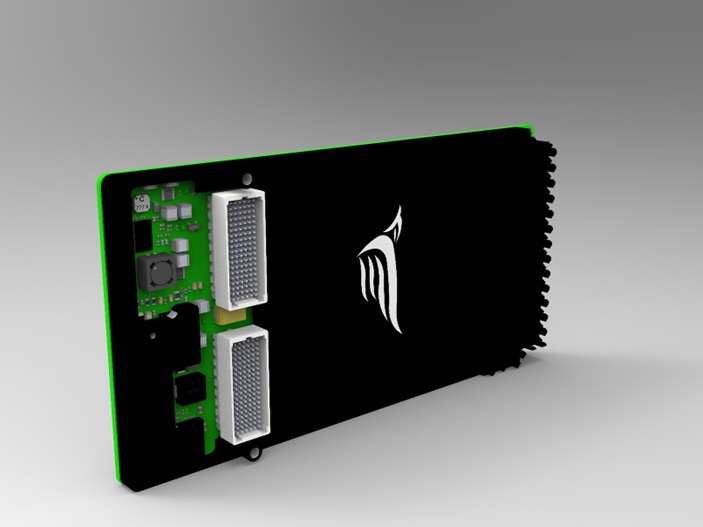
XMC16DAC8: High Speed Acoustic AWG and Signal Generator
XMC (Switched Mezzanine Card), Rugged interface VITA 42 (XMC 1.0)
- Eight channel signal generators in XMC on RF MMCX (Micro-Miniature Coaxial).
- 16-bit I/Q DACs. Sample rate programmable up to 200 MSPS.
- On board interpolation filters and direct digital synthesizer in FPGA logic.
- 4 lane Gen 2 PCI Express interface with DMA engine, 256MB waveform memory.
 Adobe Reader (free)
or other software that can open PDF files must be installed on your computer to view the documents marked "(PDF)."
Adobe Reader (free)
or other software that can open PDF files must be installed on your computer to view the documents marked "(PDF)."
High Performance Fundamentals
The XMC16DAC8 is an eight-channel high frequency (HF) signal generator in half-length half-height PCIe form factor. The card provides eight fully differential analog output channels, which are sourced from synchronous 16-bit DACs which may be clocked at up to 200MHz. The analog output is fixed at 20Vp-p differential for full scale digital inputs, and includes two pole reconstruction filtering. All other processing is performed using the on-board FPGA resources. The XMC16DAC8 includes a high precision frequency synthesizer which allows the user to generate a sample clock of virtually any frequency. It can also accept an external clock for frequency coherent synchronization to peripheral equipment. When using the XMC16DAC8, data acquisition may be performed in either loop, pulse, or continuous mode. In pulse mode a specific number of samples are converted following a trigger event. In loop mode a specified buffer (up to 16M samples) in local memory is repetitively fed to the converters. Continuous mode allows the user to feed data from the host system over the PCIe interface. The amount data acquired is virtually unlimited, but the data rate will be limited by the bandwidth of the PCIe connection. Conversion may be initiated and terminated by software commands, or by the external trigger/gate input.
On board processing
The XMC16DAC8 includes on board processing resources to support operation as a multi-channel AWG or signal generator. The card can accept data streamed from a host processor in real time, it can operate on previously buffered data, or it can generate it’s own waveform data based on a direct digital synthesis core. or the internal clock may be phase locked to a lower frequency, such as a 10MHz system reference clock.